

In this guide
Gift guide · Family games
Best family games: board and card games for easier game nights
Choose family board games and card games by player count, reading load, session length and age, with a simple checklist for a better game night.
Prefer the full buying guide? Start readingUpdated
The shortlist right now
Checked on each maker's own site10 picks, youngest age marking first, not ranked.
As an Amazon Associate I earn from qualifying purchases. Hamleys and The Entertainer links are affiliate links through Awin. Commission never decides what appears. How we earn
 Dobble Classic
The quickest game here to explain to a new player. Reactions matter more than reading, so younger and older players compete fairly, and five mini-games on 55 cards stop it going stale. Two to eight can play.
Image: © Zygomatic / Asmodee (asmodee.co.uk)
View on AmazonAffiliate link · Amazon UKView at HamleysAffiliate link · HamleysView at The EntertainerAffiliate link · The Entertainer Guess Who? Grab and Go
When the family game is really for two, such as a parent and child, this deduction game fits in a bag with its pieces stored inside. It is marked 6+ and works anywhere there is a flat surface.
Image: © Hasbro (hasbro.com)
View on AmazonAffiliate link · Amazon UKView at The EntertainerAffiliate link · The Entertainer Jumanji: The Classic Game
A film the whole family knows, turned into a board game for two to four players. Rolling through the jungle, reading each danger through the decoder and racing to the centre takes about half an hour, short enough for a school night. The box shows 6+ while Spin Master's description says 8 and up, so check it against your youngest player.
Image: © Spin Master (spinmaster.com)
View on AmazonAffiliate link · Amazon UK- Connect 4 Game
The shortest rules in this shortlist: drop discs into the grid and try to line up four. It is marked 6+, so a younger child can take on a parent on fair terms. The slider bar releases all 42 discs at the end of a round, which makes a rematch instant. Hasbro says adult assembly is required.
Image supplied by The Entertainer through the Awin product feed.
View at The EntertainerAffiliate link · The Entertainer  Ravensburger Labyrinth
For a family that wants a proper board game on a weeknight: two to four players, 20 to 30 minutes, and a moving maze that keeps adults thinking while a seven-year-old can still win.
Image: © Ravensburger (ravensburger.co.uk)
View on AmazonAffiliate link · Amazon UKView at HamleysAffiliate link · Hamleys Mattel UNO Card Game
For the nights when everyone wants to play: up to ten players, rules most adults already know, and turns that come round quickly. It is marked 7+, so check the youngest player first.
Image: © Mattel (mattel.com)
View on AmazonAffiliate link · Amazon UK- Battleship Classic Board Game
When the family game is a head to head between two players, this one needs no reading at all: hide ten ships, call coordinates and mark the hits with red pegs. Each player has their own portable case, so it packs away and travels. Marked 7+, and Hasbro says adult assembly is required.
Image supplied by The Entertainer through the Awin product feed.
View at The EntertainerAffiliate link · The Entertainer  Ticket to Ride: London
A taste of modern strategy games for a family that has outgrown roll-and-move. Collecting cards to claim bus routes takes about ten to fifteen minutes with two to four players, short enough for a second round.
Image: © Days of Wonder / Asmodee (asmodee.co.uk)
View on AmazonAffiliate link · Amazon UKView at HamleysAffiliate link · Hamleys Trivial Pursuit Family Edition
Quiz night that does not leave children behind: separate adult and child question cards, 2,400 questions in all, so everyone at a mixed table answers questions written for them.
Image: © Hasbro (hasbro.com)
View on AmazonAffiliate link · Amazon UK- Monopoly Deal Card Game
For a family that loves Monopoly but not its length: the card version keeps the rent and the trading, takes two to five players and can be over in about fifteen minutes. Marked 8+.
Image supplied by The Entertainer through the Awin product feed.
View on AmazonAffiliate link · Amazon UKView at HamleysAffiliate link · HamleysView at The EntertainerAffiliate link · The Entertainer
Before you choose
The best family game is the one your particular group can start, finish and want to play again. Box claims matter less than the people at the table, the time available and how comfortable everyone feels with the rules.
Choose for the group, not the loudest player
List the real players before looking at games. Note the youngest participant, comfortable reading level, tolerance for competition and usual group size. A game labelled for four people may still be a poor fit if one player waits too long between turns.
For mixed ages, look for rules that can be explained through a sample turn. Hidden information and meaningful choices can keep adults interested, while a clear goal helps younger players participate.
Family board games by the youngest player's age
The manufacturer's age marking is the right starting point, and the youngest player decides it. In this guide, Connect 4, Dobble Classic, Guess Who? Grab and Go and Jumanji: The Classic Game are marked 6+, Battleship, Labyrinth and UNO 7+, and Ticket to Ride: London, Monopoly Deal and Trivial Pursuit Family Edition 8+. Jumanji is the one to look at twice: its box shows 6+ while Spin Master's product description says 8 and up, so read the packaging against your youngest player before wrapping it.
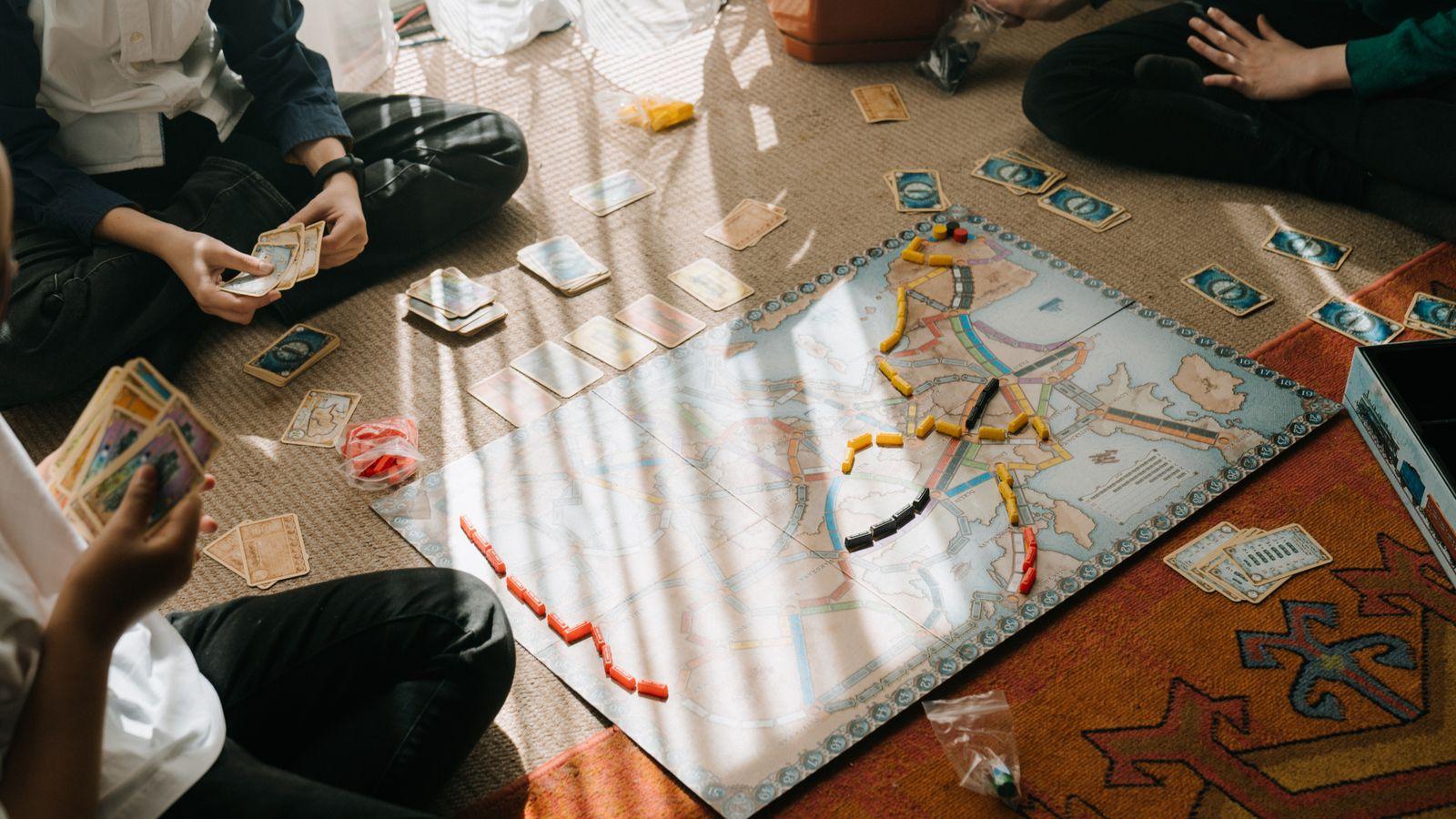
For a first proper board game, choose short rounds and a clear goal. Labyrinth (2–4 players, 20–30 minutes) and Ticket to Ride: London (2–4 players, roughly 10–15 minutes) fit a weeknight. For a big mixed-age group, card games cope with more people: UNO lists 2–10 players and Dobble 2–8.
Planning for Christmas Day? Our Christmas family games list is built for a bigger, mixed table: eight games sorted by headcount and play time, including two marked for older players.
Family board games in this guide
Seven of the ten games here are played on a board or a grid. Labyrinth and Ticket to Ride: London suit a family that wants decisions lasting the whole game: one shifts the maze under every player, the other has you collecting cards to claim London bus routes. Trivial Pursuit Family Edition is the pick for a table of mixed ages, because children and adults draw from separate question cards.
Connect 4, Battleship and Guess Who? Grab and Go are made for two, so they suit a parent and child better than a full table. Jumanji: The Classic Game puts a familiar film on the board for two to four players: roll the number die to move through the jungle, hold each danger card against the decoder to reveal it, and race to the centre in about thirty minutes. The rescue dice and sand timer give the table something to shout about, which is often what a family evening needs.
If every player is a child, our guide to board games for kids starts younger and sorts each game by the maker's age marking.
Family card games: Dobble, UNO and Monopoly Deal
Card games earn a place in the family cupboard because they are small, quick to set up and cope with a crowd. UNO takes up to ten players, the most of any game here, and most adults already know how it works. Dobble takes two to eight and rewards quick eyes rather than reading, since every round is a race to spot the one symbol two cards share.
Monopoly Deal is the card game for a family that enjoys trading and a little ruthlessness. It fits the rent and property sets of the board game into 110 cards, and Hasbro says a game can be over in about fifteen minutes. It is marked 8+, so it suits older children better than Dobble, which is marked 6+.
A pack of cards also travels well: take one on a long car journey, to the grandparents' house or into the quiet hour after Christmas lunch.
How to pick a family card game
A family card game is simply one played from a deck rather than a board, which is why it packs into a bag, sets up in seconds and usually seats more people than a board will allow. Decide the group size first, then the time you have, then how much reading the youngest player can manage on their own.
Three in this guide cover most evenings: Dobble for speed and mixed ages, UNO for a crowd, Monopoly Deal for older children who enjoy haggling over property.
- Player count: UNO lists 2 to 10 players, Dobble 2 to 8 and Monopoly Deal 2 to 5.
- Reading load: Dobble needs none, while Monopoly Deal asks players to read action cards.
- Length: Dobble runs about 15 minutes, and Hasbro says Monopoly Deal can finish in 15.
- Age marking: Dobble 6+, UNO 7+, Monopoly Deal 8+, matched to the youngest at the table.
- Portability: a deck survives a car boot or a holiday bag better than a box of small pieces.
Believe the time you actually have
A 20-minute game that reaches the table is more valuable than a two-hour game nobody starts. Include teaching and setup time when judging a box estimate, particularly for the first session.
Keep one quick option available for weeknights and save deeper games for planned sessions. A standard deck is useful because the same pack supports many lengths and levels of complexity.
Monopoly Deal is a good example of a weeknight game: Hasbro says it plays in as little as 15 minutes, for two to five players aged 8 and up, and it keeps the trading and rent of the board game in 110 cards.
Searches for board games climb from the start of November and peak in December, so the familiar family titles are busiest to shop for at the point you most want them. If a game is meant for Christmas Day, buy it early enough to read the rules, do any assembly and try one practice round first.
Games for children are the fastest rising part of that search, up 90 per cent, so the titles marked for younger players tend to be the ones picked over first. If you are buying for a child's own shelf rather than the family table, settle on it in early November rather than mid December.
Reduce the common sources of friction
Early player elimination, fiddly scoring and rules that depend on one expert can all flatten a family evening. Cooperative games are one option, but competitive games can work just as well when turns stay short and setbacks do not end a player’s involvement.
If one person always teaches, ask whether the rules are clear enough for another person to take over next time. Independence from a permanent referee is a strong sign of replay value.
- Check the supported player count, including the two-player experience.
- Compare play time with the youngest player’s attention span.
- Look for readable cards, visible pieces and manageable setup.
- Decide whether direct competition suits the group.
Match the game format to the group
Dobble and UNO support short, familiar rounds; Guess Who? Grab and Go is a compact two-player deduction game. Labyrinth and Ticket to Ride: London add more spatial and route-planning decisions, while Trivial Pursuit Family Edition separates adult and child question cards.
Jumanji: The Classic Game is the most theatrical choice in this shortlist, with 30 danger cards that arrive one surprise at a time and a sand timer to hurry everyone along. The right starting point still depends on the group's reading confidence, appetite for competition and available time.
Two older classics cover the evenings when only two people are playing. Connect 4 asks each player to line up four discs in the upright grid, and the slider bar empties all 42 discs when the round ends, so a rematch starts straight away. Battleship gives each player a portable case, ten ships and pegs for calling out coordinates, with no reading involved. Hasbro states that adult assembly is required for both, so put them together before the first game rather than on the night.
Manufacturer-checked facts
Product details
Ten checked games cover observation, cards, routes, trivia, deduction, grid strategy, property trading and a jungle race against the sand timer. Check player count, session length, reading demands and the age marking printed on the box you are buying.
Observation card game
Dobble Classic
In the box: 55 cards; 57 symbols; 5 mini-games; 2-8 players; about 15 minutes
- Age guidance
- 6+
- Brand
- Zygomatic / Asmodee
- Model / item
- Classic 55-card edition
- Facts checked
Two-player deduction game
Guess Who? Grab and Go
In the box: Portable two-player guessing game with integrated storage
- Age guidance
- 6+
- Brand
- Hasbro Gaming
- Model / item
- Grab and Go edition
- Facts checked
Board game / family
Jumanji: The Classic Game
In the box: Gameboard, 4 plastic movers, sand timer, 2 mover stands, number die, 4 rescue dice, 30 danger cards, card decoder, punch sheet; 2-4 players, about 30 minutes
The box shows 6+, while Spin Master's product description says 8 and up, so check the box against the youngest player.
- Age guidance
- 6+
- Brand
- Spin Master
- Model / item
- 6061775
- Facts checked
Game / strategy game
Connect 4 Game
In the box: Grid, 2 legs, slider bar, 21 red discs, 21 yellow discs and instructions; for 2 players
Hasbro states that adult assembly is required.
- Age guidance
- 6+
- Brand
- Hasbro
- Model / item
- A5640
- Facts checked
Family strategy game
Ravensburger Labyrinth
In the box: 2-4 players; 20-30 minutes; board, 34 maze cards, 24 treasure cards and 4 pieces
- Age guidance
- 7+
- Brand
- Ravensburger
- Model / item
- 26448
- Facts checked
Family card game
Mattel UNO Card Game
In the box: 2-10 players; classic colour-and-number matching card game
- Age guidance
- 7+
- Brand
- Mattel
- Model / item
- W2087 / MATW2087A
- Facts checked
Game / strategy game
Battleship Classic Board Game
In the box: 2 portable battle cases, 10 plastic ships, 73 red hit pegs, 168 green miss pegs and instructions; for 2 players
Hasbro states that adult assembly is required.
- Age guidance
- 7+
- Brand
- Hasbro
- Model / item
- F4527
- Facts checked
Family route-building game
Ticket to Ride: London
In the box: 2-4 players; approximately 10-15 minutes; compact London route-building game
- Age guidance
- 8+
- Brand
- Days of Wonder / Asmodee
- Model / item
- DOW720061
- Facts checked
Family trivia game
Trivial Pursuit Family Edition
In the box: 2+ players; 2,400 questions with separate adult and child cards
- Age guidance
- 8+
- Brand
- Hasbro Gaming
- Model / item
- E1921
- Facts checked
Games / card game
Monopoly Deal Card Game
In the box: 110 cards (Property, Wild Property, Action and Money cards) for 2 to 5 players; the first to collect 3 complete property sets in different colours wins; Hasbro says a game can take as little as 15 minutes
- Age guidance
- 8+
- Brand
- Monopoly
- Model / item
- G0351
- Facts checked
Questions
Common questions
- What should I check before buying a family board game?
- Check the real player count, youngest player’s reading needs, setup time, expected session length, elimination rules and whether the group enjoys direct competition or cooperation.
- What is a good board game for a 6-year-old?
- Start with a short game with a clear goal. In this guide, Dobble Classic and Guess Who? Grab and Go are marked 6+ by the manufacturer. Labyrinth and UNO are marked 7+, so check the marking against the youngest player before choosing them.
- How can we make a new family game easier to learn?
- Read the rules before the session, set up in advance, demonstrate one sample turn and begin with the smallest useful ruleset. Add optional rules after everyone understands the core loop.
- What are family games?
- Family games are board and card games a mixed-age group can learn together and finish in one sitting. They usually take two or more players, keep turns short so nobody waits long, and set a goal a child can follow while adults still have real decisions to make. The age marking on the box tells you who the publisher designed the game for, and the youngest player at the table decides whether it fits.
- What are good family card games?
- Three card games in this guide suit most families. UNO copes with the biggest group, up to ten players. Dobble Classic is the fastest to learn and depends on reactions rather than reading, for two to eight players aged 6 and up. Monopoly Deal, marked 8+, suits older children who like trading and plays in about fifteen minutes.
- What is the best family board game for all ages?
- No single game suits every family, so judge it by the group. For a wide age range, pick one where the youngest player meets the age marking, turns come round quickly and nobody is knocked out early. Fast observation and matching games such as Dobble Classic and UNO stretch across ages because reactions and luck count as much as planning. Connect 4 and Battleship are worth keeping for the nights when only two people are playing.
- What are family board games?
- Family board games are games played on a board or grid that a mixed-age group can learn together and finish in one evening. Turns stay short, the goal is clear enough for a child to follow, and the adults still have decisions worth making. The ones on this page are Labyrinth, Ticket to Ride: London, Trivial Pursuit Family Edition, Jumanji: The Classic Game, Connect 4, Battleship and Guess Who? Grab and Go, and they range from 6+ to 8+ on the maker's marking.
Research
Sources checked
We use official safety guidance and manufacturer sources for specific product claims. Retailer popularity can inform discovery but does not replace these checks.
- Office for Product Safety and Standards: buying toys safelyUK guidance on age restrictions, warnings, small parts, batteries and trusted sellers.
- Toys (Safety) Regulations 2011: Great BritainOfficial guidance on toy safety requirements, warnings and instructions in Great Britain.
- Google Search Central: helpful, reliable, people-first contentEditorial standard used for this guide library: useful, original and clearly sourced content for readers.
Each pick's identity, age marking and contents were checked on its maker's own page:
- Zygomatic / Asmodee: Dobble Classic
- Hasbro Gaming: Guess Who? Grab and Go
- Spin Master: Jumanji: The Classic Game
- Hasbro: Connect 4 Game
- Ravensburger: Ravensburger Labyrinth
- Mattel: Mattel UNO Card Game
- Hasbro: Battleship Classic Board Game
- Days of Wonder / Asmodee: Ticket to Ride: London
- Hasbro Gaming: Trivial Pursuit Family Edition
- Monopoly: Monopoly Deal Card Game
Keep exploring